
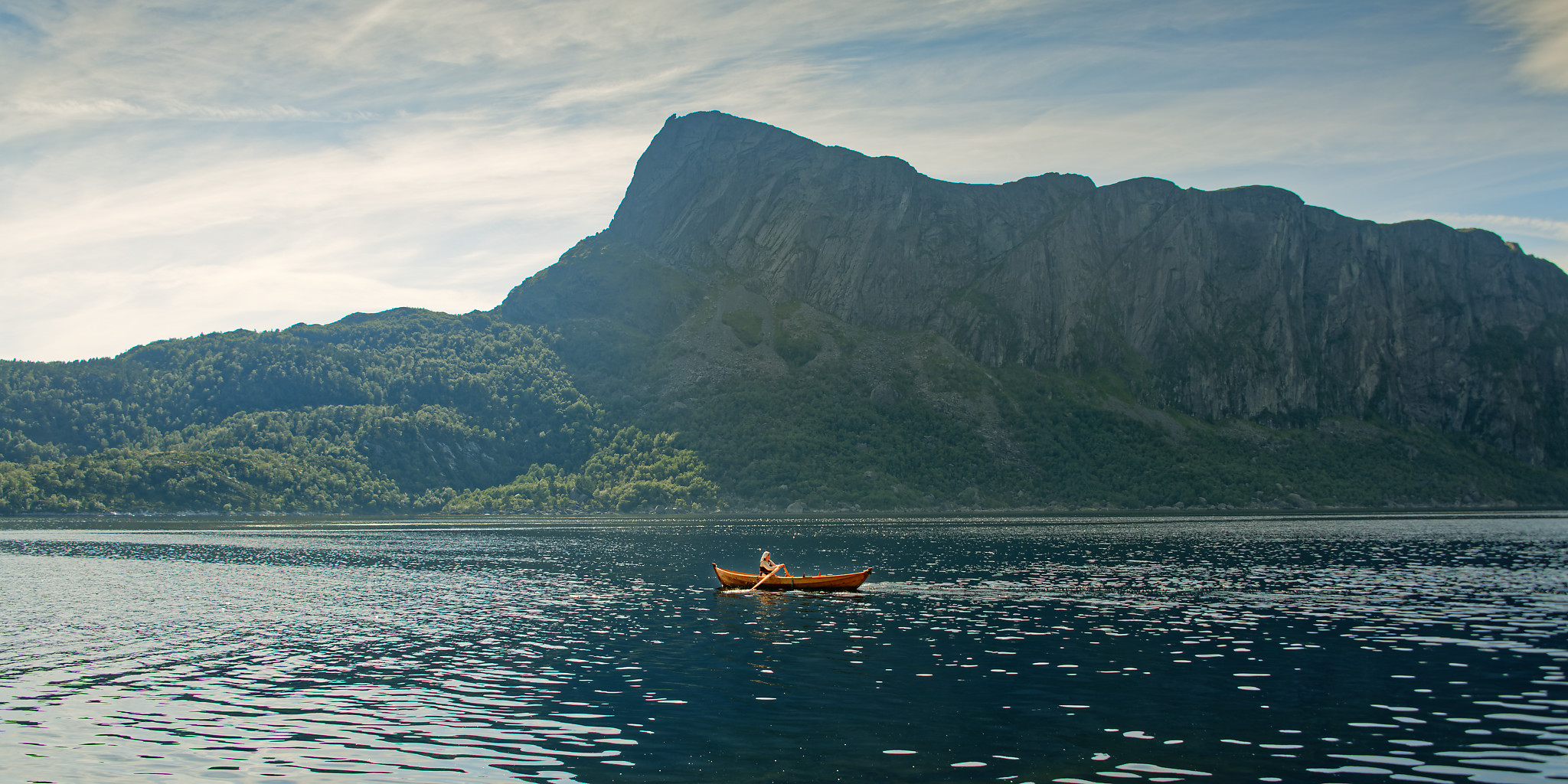

At Viking Footprints, we are rightly proud of the depth of history around us. Within just a short hour or so drive in a modern iron box with wheels on it you can come into contact with the footprints of virtually the whole viking story. It truly is – the Viking Coast.
Our intention is to provide visitors to our area of Norway with a fun and relaxing introduction to the smaller details of the Viking story and to be centre for learning, courses and discussion around the Viking Age and also the subsequent footprints it left behind.
But the Viking Coast. What is that exactly?
Well, it’s a term we came up with to describe this part of west Norway in a historical context. It’s inspired by the idea of this area also being Fjordkysten in Norwegian – the Fjord Coast, in English. That’s now the marketing tagline for this little visited part of west Norway. While many visitors to the western fjords end up at the popular cruise destinations like Flåm and Olden, or base their road trips on the main road network. Out here, on the Fjord Coast – there is just as much beauty, interest and history. And also out here is a huge amount of significance in relation to the history of Norway and the Viking Age in particular.
In part one of this blog entry, we are going to deal with some of the most significant aspects of the Viking Age that we have begun to understand – and appreciate – far more in the past 30 or 40 years, than we have ever done so before. Trade and the Law. And how, here locally on the Viking Coast, these played a major role in developments here in during, what we will loosely call, the Viking Age. Developments that had far reaching consequences – or as we would like you to think of the – footprints.
Trade in the Viking Age

Here specifically, in Hyllestad, where Viking Footprints is based, we have some of the firmest evidence of just how important – and large – trade was during the viking age. As in any society in history – including our own – the production of food was of fundamental importance. Here in west Norway, it was, and indeed still is, difficult to grow grain crops. We take grain and its importance to our food supply for granted in modern times from bread to pasta to beer. We just have to look at the pressures on global food prices in the past few years and the causes of that to realise that perhaps we sometimes take TOO much for granted.
But in past times, food production was very much on the edge. It did not take a lot for people to fall into times of malnutrition and starvation. Farming was an innovation of the neolithic period and by the late iron age it had become central to sustaining populations and their growth. Here in Norway, there were significant problems in expanding farming – the lack of good land for crops is apparent in many places outside of the rich farming areas of south east Norway and Trøndelag. So here in our place in west Norway, grain crops were not grown because of the geography and climate. And that’s still the case to this day.
However, something else was produced right here on the Viking Coast that was fundamentally connected to grain production and its importance in food supply. And that was the humble mill stone, or kvernstein in Norwegian. So even though this area did not produce the grain itself, it supplied a huge number of these ready-made millstones. The production, here in Hyllestad, we think started just before the Viking Age at the end of what we term the Migration Era here in Norway. Initially these were small stones that could work grain by hand, while later into the Middle Ages, much larger stones capable of being driven by water were also produced.
Mill stones from the quarries here in Hyllestad far outnumbered what would be needed simply for local markets. And we are talking about thousands here – with the peak production around the latter period of what we might term the Viking Age. So where did the rest go? And how many? Well, we can begin to answer that question because the type of stone used in the production is very specific – garnet mica schist – a metamorphic rock that is layered, rough and contains small specks of red which are garnet crystals. In fact, the type in Hyllestad is so unique that we know if a mill stone is found elsewhere of and it’s made of this type of rock then it will have come from the quarries in Hyllestad. Using this geological ‘signature’ we know that millstones quarried here ended up as far as northern Germany, Sweden and even Iceland. And that their numbers were likely in the thousands.
To achieve this, it must have meant an organised workforce – possibly involving slaves, and what must have been a well-developed logistics’ network, using ships to transport the goods. Indeed, the local archaeological evidence points to just that. Evidence that includes not only harbour and loading places, but also a few unfortunate cases of sunken cargo with the millstones ending up at the bottom of the fjord.
It would have required established trading links so the goods could be bought and sold across much larger distances. For millstones from Hyllestad to end up where they did, this also requires many intermediate traders, merchants and dealers.
So here in Hyllestad, where Viking Footprints is based, trade is the dominant story of the Viking Age. A trade in a product produced on an industrial scale for the time and a product which served a demand that was European wide, and one for which food produced locally had little need for. It is, in fact, one of the earliest examples of trade on this scale in Scandinavia, and shows that it was an important driver of economic activity during the Viking Age. We often think of the dominance of RAID as a Viking Age activity, but we also know now, that TRADE was equally significant, and in terms of the footprints that the Viking Age left, perhaps the more important of the two.
Politics and Society: Gulating

A popular view of the vikings as violent thieves and pirates is largely as a result of what was written down by those on the receiving end of viking raids in the late 8th century CE and in the 9th century CE. It portrays the vikings as representing a rather unruly and savage society. However, at home here in Norway, nothing could be further from the truth.
In actual fact, viking age Norway had a highly developed and sophisticated legal system. And not only was there a framework for behaviour, property ownership and the regulation of society in general, there was in addition a system for the resolution of disputes.
These features of viking age Norway were administered through what is known as the ting system. A ‘ting’ was an organised body of decision makers who met at a single place both to set laws and administer justice. Small ting sites fed into a larger system where a regional level ting would have the final say on matters on both the content of the law and its working. So, in some important respects, it was both a legislature, a body for making laws, and a judicial system for determining the outcome of justice.
Decision makers were the representatives of geographical areas chosen and sent to the ting to argue on behalf of their community. Although the Greeks get the credit for the invention of democracy, viking age Norway provides the model of representative decision making that has become the dominant model of democratic societies in the modern era. And although representatives at a viking ting were not ‘elected’ in the modern sense, they would have had to carry the authority of those they represented and so would have needed their support.
Here in west Norway, on the Viking Coast, the regional ting was held in the province of Gulen, just on the south side of Sognefjord from where Viking Footprints is based. It was known as the Gulating and its importance before, during and immediately after what we call the Viking Age can’t really be understated. Along with Borgarting, Eidsivating, and Frostating, the Gulating was one of the four great historical regional assemblies of the Viking Age.
It also provided an important power base in the centuries of struggle that saw the establishment of the unified Kingdom of Norway. Indeed, here in west Norway there was a powerful counter force to several of the early Kings of Norway and their desire to centralise political control and sweep away regional independence.
The great ting system was eventually merged under the King Magnus Lagabøte, Magnus the Lawmender into a single national structure in 1274 – which to this day provides the underlying framework of the Norwegian judicial system. 2024 marks the 750th anniversary of this unifying event in Norwegian history.
But returning to the Gulating and its importance for our understanding of Viking Age law and society, what is really interesting is that in the late medieval period around 1250, the Gulatingslova – the laws of the Gulating – were written down and can still be read today. Although you have to go to a museum in Denmark to do that. Why, is another story entirely.
But by studying the later medieval form of the Gulating laws we are not so far removed from the Viking Age that we cannot imagine that many of things that are detailed there were not also features of how the legal system and society were structured a couple of hundred years earlier. They are, without a shadow of a doubt, a genuine Viking Footprint.
The laws of the Gulating, and other documentary and archaeological sources, give a fascinating insight into the surprisingly progressive thought that existed at the time. This is particularly true of the rights that were afforded to women. A woman’s value – in financial terms in relation to compensation for less – was deemed to be equal to that of a man. A woman had the right to own property – land, buildings, and ships. A woman even had a legal right of divorce. And although a woman could not directly be a representative at a ting, she could if she was a widow to a, now dead, male representative.
The laws regulated the brewing of beer, the building of churches and the carrying of weapons in public. And far from indicating a chaotic and savage society there were all sorts of penalties for violent crime from beard pulling to miskilling. Yes, you heard correctly, miskilling. That would be where you had a legitimate reason to kill someone, but when you carried out the deed, the method you used was not considered, in law, honourable enough. There would be a fine to pay.
What’s also fascinating about these ancient legal frameworks was how much honour and family connection underpin principles of justice. So legal liability in the Viking Age is not individual as it largely is now, but it is collective. Meaning if you commit a crime, it’s not just you personally who will pay the price – literally, in some cases – but also your family. If there’s anything that’s going to stop you from striking that sword blow, then it’s the thought of your family’s honour at stake too.
So here, on what we’ve described as the Viking Coast, and right on our doorstep here at Viking Footprints, are two very clear examples of the fascinating story that can be found if you dig just a little deeper into the Viking Age. Carry on the conversation in the comments below if you have anything to add or ask. We would be happy to hear from you.
In the next part, we will cover some of the other interesting places that we have here on the Viking Coast. Thanks for reading.
