
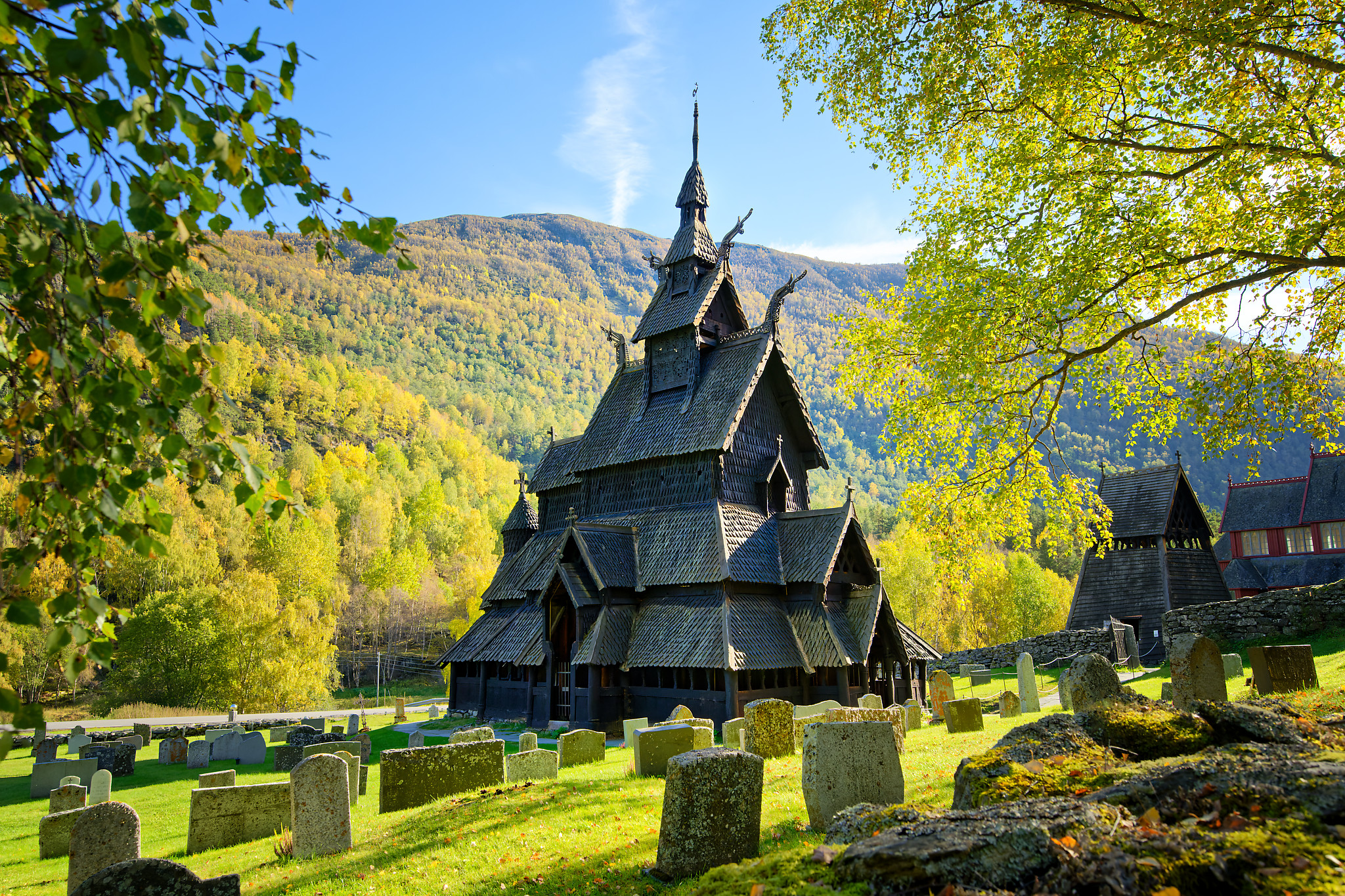
Regular visitors to my social media pages will already understand my fascination with Norway’s stave churches. These (largely) medieval structures are incredible, not only for the fact that these wooden buildings have survived centuries, but in particular for their window into the past. They offering tantalising glimpses into the beliefs and culture of medieval Norway that have clear echoes of the Viking Age and earlier still lingering in their timbers.
My stave church obsession started as a small boy – interested in becoming an architect (yeah, ok, I didn’t get there!) – who marvelled at a black and white picture of a Norwegian stave church in an encyclopædia, and was amazed by its shape and decoration. It turns out that picture was of Borgund stave church and that many years later, I’d find myself living just an hour away from it!
My appreciation and love of these buildings have only deepened over time, and I now love to bring guests on my guided tours to some to enjoy the magic for themselves. Estimates suggest that there may have been as many as 2000 of these churches in medieval times, but today, only 28 survive. That makes choosing a top 10 a little easier, though, by no means straight forward. So, here are my top 10 Norwegian stave churches and a little of my own ideas as to why. The list is in no particular order (that would be impossible)!
1. Urnes


I think it would be hard not have Urnes on anyone’s top 10. It’s probably the oldest, with timbers that were felled around the year 1130 as a starting point. It’s also the only one, in fact, that is a UNESCO World Heritage Site. That status comes from the unique set of carvings on the exterior of the building. These were most likely part of an earlier stave church on the site, probably the original door portal.
The carvings are a statement of art and belief in Norway in these early years after the conversion to Christianity. They contain an organic, otherworldly writhing and seething web of plants and mystical beasts. So clear is their style that these carvings at Urnes give the last great, style of Viking Age art its name – the Urnes style. It can be found in many archaeological finds, largely metal work jewellery and brooches – and many from before the conversion process took hold.
For me personally, it’s the combination of the carvings, and the location of the church on a hill shelf above the beautiful Lustrafjorden which seals its place in my top 10. It’s most likely that this was a religious site in pre-Christian times and the placing of the church here is no coincidence. It’s both a beautiful and magical place as a result.
2. Borgund


Borgund would always be in my top 10 just for the reason of my boyhood memory of its picture in an encyclopædia. But it also happens to be one of the best preserved and most authentic of the stave churches. Add to that, its location in the beautiful Lærdal valley, and the details that it brings to the stave church story, then it belongs it anyone’s top 10.
Borgund was probably built in the middle of the second half of the 1100s. That makes it around 850 years old. Incredible for a wooden building. Its exterior stands starkly dark in the colour of the fields and trees, mountains and sky around it. It may seem smaller than you imagine, but when you get closer, its roofs and spire reach for the sky, as do the dragon motives on the corners of the roof apexes, and echo of older Norse beliefs.
Enter through the carved door portal, you pass to another world, and inside, the dark interior reflects the reality of early medieval life here in Norway. There are no windows, no seats – just as it would have been in the 12th century. There are also details that you could so easily overlook that give a mind-blowing insight into the past. Take the runic inscription ‘graffiti’ outside the main door – a man called Tor rails at being late for the mass of St Olav but blames the Norns of Norse mythology for that fact. The Norns were 3 goddesses who weaved the fate of humans. Tor clearly lived in a world where he, at least, was convinced that the old gods were still around.
3. Heddal


Heddal stave church in Telemark is the biggest of the remaining 28 stave churches in Norway. Unlike my first two choices, Heddal is still in regular use as a church – very popular to have weddings here. Dating Heddal is a bit problematic. Some timbers have been dated to the 1100s, but it’s thought the main construction may be from the early 1200s. It’s had restoration work done in the 1840s and again in the 1950s – not wholly successfully. It’s an imposing building in the flat valley area around the village of Heddal and so it dominates the area around it.
Heddal’s remaining door portals show what may be an interesting contrast between carvings on the exterior, reflecting the older, and pre-Christian belief system, but inside more clearly Christian symbolism is displayed. But even this is not entirely consistent. One of the remarkable legacies of the interior is the so-called Bishop’s chair which on seat back rest has a carving depicting the story of Brunhilde and her 2 suitors, Gunnar and Sigurd from the Saga of the Volsungs – a pre-Christian, Viking Age, set of myths written down at the time the church was built.
I include Heddal in my top 10 just for its shear visual impact. As the largest of the remaining stave churches and its hybrid design, it rises in an other-worldly fashion from its surroundings and seeing it up close is an impressive experience.
4. Nore


Nore is one of four stave churches that lie in one of Norway’s most interesting valleys – Numedal. Here in the space of an hour’s drive are not only these 4 incredible churches, but also Norway’s highest concentration of other medieval wooden buildings.
Nore lies in the upper part of Numedal, in the valley floor and close to the network of small lakes and the river which characterises the area. The church dates back to the mid-1100s. It has a cruciform layout, a little different from many stave church designs. Its setting in the valley is a beautiful and tranquil site. The exterior has seen some changes in the 1700s, but step inside and the magic really begins.
You will notice immediately the cruciform design is support by staves in the centre of the church (many others have the staves only around the edges. But the highlight are the interior paintings – lavish in decoration and colour. These are later than the building itself – from the 1600s/1700s. And it is the combination of the interior paintings and the church’s quiet valley setting that put it firmly in my Top 10.
5. Uvdal


Uvdal stave church is the second of the Numedal valley churches to make my Top 10. It’s in the uppermost part of the valley, high on a south facing hillside and on the edge of the rising mountains that eventually end up on Hardangervidda, Norway’s largest and wildest mountain plateau. This area has, back to prehistoric times, been a means of passage for people travelling from the lower parts of the east of Norway into the fjords of the west.
Uvdal is a similar cruciform shape to Nore down the valley. It’s had some extension, but a large part of the church is original and again, like many others dates to the 1100s. Uvdal is a mystical place. It’s dark inside, but the few shafts of light that enter through the west portal light up the richly painted interior. These paintings, like the ones in Nore are later from the 1600s, but incredible in the atmosphere they create inside the tiny interior.
Uvdal has mysteries – like the 4 girls whose mummified bodies from the 1300s were found to be buried under its floorboards. Or the easy to miss carvings on the west portal that depict not stories from the Bible, but stories from an earlier time of Norse mythology. Gunnar playing his harp in the snakepit – a myth only first written down in Scandinavia in the early 1200s, part of the Saga of the Volsungs. It’s incredible to think that the carved depiction here may actually pre date the time that this story was first written down. These are only a small number of the many fascinating aspects about Uvdal. It’s a beautiful place, but its mysteries alone make it worthy of a place in my Top 10.
6. Reinli


Reinli lies high up on the mountainside above Bagn in the traditional district of Valdres. It’s a remote and impressive location. The church is in a rectangular form with a roof upon a roof design. Its appearance is closer to more conventional continental church designs of its time. That time could be from the late 1100s. Radio carbon dating puts some of the timbers in that period.
But Reinli’s history goes back to the Sagas. It’s said that Olav the Holy (Norway’s great convertor King and first Saint) visited a church at Reinli in the year 1023. Research work under the current building does give evidence of an earlier church here that probably burned down. Indeed, it is suggested that here (like a number of other locations), there may have been an even older building in pre-Christian times used as a place of ritual.
Reinli has no grand tower structures, and the church bells are located in a separate bell tower at the gate to the church enclosure.
Though it doesn’t take more than around 20 minutes to get up to Reinli from the main E16 road, its location gives a greater sense of remoteness than just about any of the stave churches in Norway. It’s position high above the valley gives it a sense of place and history together. It’s that impression that puts Reinli into my Top 10.
7. Grip


Grip is unique amongst the remaining stave churches as it’s on an island. The island of Grip. Grip lies around 12 kilometres (8 miles) off the west Norwegian coast at Kristiansund. That alone might be reason enough to include it in my Top 10. But that’s far from the only reason.
The church was built in the 1300s. So it is immediately a testament to the size and importance of this tiny fishing community way back to the medieval period. Norway is build on the experience of the sea and life that can be built from it. Nowhere is that more apparent in the small island communities such as Grip.
The church is functional in design and appearance. It’s tiny (only Undredal is smaller). And it is located in the middle of the island at its highest point (which is only 10 metres, 30 feet above sea level). There’s good reason for that. In times of great storms, the highest place on the island became a sanctuary – the church being there, offered that in more ways than one.
Church records suggest that there was a priest permanently living on the island until the mid 1600s, after which the priest had to serve the communities of several of the islands close by.
Grip is no longer permanently occupied – it’s not allowed to live here due to the difficulty in delivering services that modern society demands. All of the properties are therefore second homes now, visited largely in the summer months.
Grip’s location and history are just incredible. Here is the real Norway. For that reason, this tiny little historic building makes it into my Top 10.
8. Øye


Øye has perhaps the most interesting, strange and mysterious story of all the stave churches in Norway. It’s located in the upper part of the valley at Vang in Valdres and close to the King’s Road – the historic pathway from the east to the west of Norway.
In design and age, it looks quite similar to Reinli. But not everything is what it seems. Firstly, the church is not in its original position. It used to be around 400 metres (1300 feet) closer to the river system that flows into the Lake Vangsmjøsa at Vang. But there, lay a problem. The position close to water meant that the church and graveyard were regularly flooded. And indeed, there are accounts of coffins and bodies being washed up and ending up in the lake. Not ideal.
In the 1600s it was decided that a new church should be built, higher and further away from the flood zone. However, this did not happen until the 1740s. At which point all record of the old stave church disappears. Torn down, yes. But no further documentation. A new church was built.
Then, almost 200 years later, in the 1935, during some renovation work to the foundation of the ‘new’ church, an incredible discovery was made. A significant proportion of the original stave church was found to be ‘buried’ under the floor of the new church. The staves, foundation pillars, support frames and even decorative pieces were found. Yet no one knows why they were put here, and indeed, there is no record of them having been put here, so as a result, no one knew they were there.
In the 1950s plans were put in place to reconstruct the old stave church close to the new church and in 1965 the work was completed and the church reconsecrated as an official part of the Church of Norway.
I am fascinated and in awe of this story and what it tells us about Norway and rural Norwegian society, folklore and belief. It would not be out of place in a novel. Yet it is the true story of this amazing place. And it belongs firmly in my Top 10 as a result.
9. Eidsborg


Eidsborg stave church in Telemark is, next to Borgund, one of the best-preserved stave churches in Norway, despite the numerous minor alterations made over the centuries. And it is still a working parish church almost 800 years after it was built. It’s a small ‘long church’ in design and probably was built in the mid to late 1200s. The only significant addition to the original building is the small bell tower from 1720s.
More recently, under the floor, a fireplace was found from much older times and potentially pre-Christian times. There is, like other places, a suggestion that a pre-Christian ritual site may have been situated where the church was subsequently built. Was the fireplace used in offerings the Old Gods? We just don’t know, but the area has deep history from the Viking Age and before. It’s quite close to an ancient quarry system that produced whetstones in large quantities. Whetstones are what everyone used to sharpen their metal tools, knives, axes etc. Such is the size of the production here, that it’s known that this was an almost industrial scale endeavour – with whetstones from here being traded and exported widely.
The church at Eidsborg is right next to the equally fascinating West Telemark Museum. Here, you will find Stålekleivloftet – a medieval ‘loft’ building bult in wood 2 minutes walk away. Research has indicated that it is dated to 1184. This makes it one of the oldest secular (non-religious) wooden buildings in the world!
For me, coming to Eidsborg was a revelation of history and how unbroken the experience of life can be in parts of Norway. The church, its story and the neighbouring history at the museum are an incredible combination worthy of my Top 10.
10. Hedalen


The stave church at Hedalen is a little more off the beaten track. Still, it’s only a 30 minute or so drive from the main E16 road and in the southern part of the traditional district of Valdres.
Hedalen is another church with quite a story. You will see that the front part is very similar to the church further up in Valdres at Reinli. This original part of the church and the centre of the cruciform shape dates to 1160. The wider cruciform and tower were added in the early modern period, most likely in the 1600s.
There are 2 things that, for me, give Hedalen a place in my Top 10. The first is the door portal. It is richly carved and one of the earliest and best preserved in Norway. It’s quite unique with three large, winged dragons entwined with flowing organic branches and leaves. It is quite stunning.
The second aspect of Hedalen that makes it so special is the fact that for around 150 or more years, it was abandoned. After the Black Death hit Norway in 1349, so many of the local population did not survive here that the local community disappeared, as did the need for the church. It was only in the late 1500s that the population had recovered and returned to the point where the church began to be used again.
In 1733 the church book records a story from 1558. It’s recorded that a hunter shot an arrow in the forest at a bird. It missed. But it hit the church bell which rung out. The hunter thought the church belonged to the hulder folk – supernatural beings in folklore. The hunter threw a flint stone over the church as a way of securing the building and its contents from the supernatural forces. And inside the church? The hunter found a bear was living here and shot it.
Whether the hunter story is true or part of folklore, it matters not. Whatever the truth, Hedalen deserves its place in my Top 10.
