
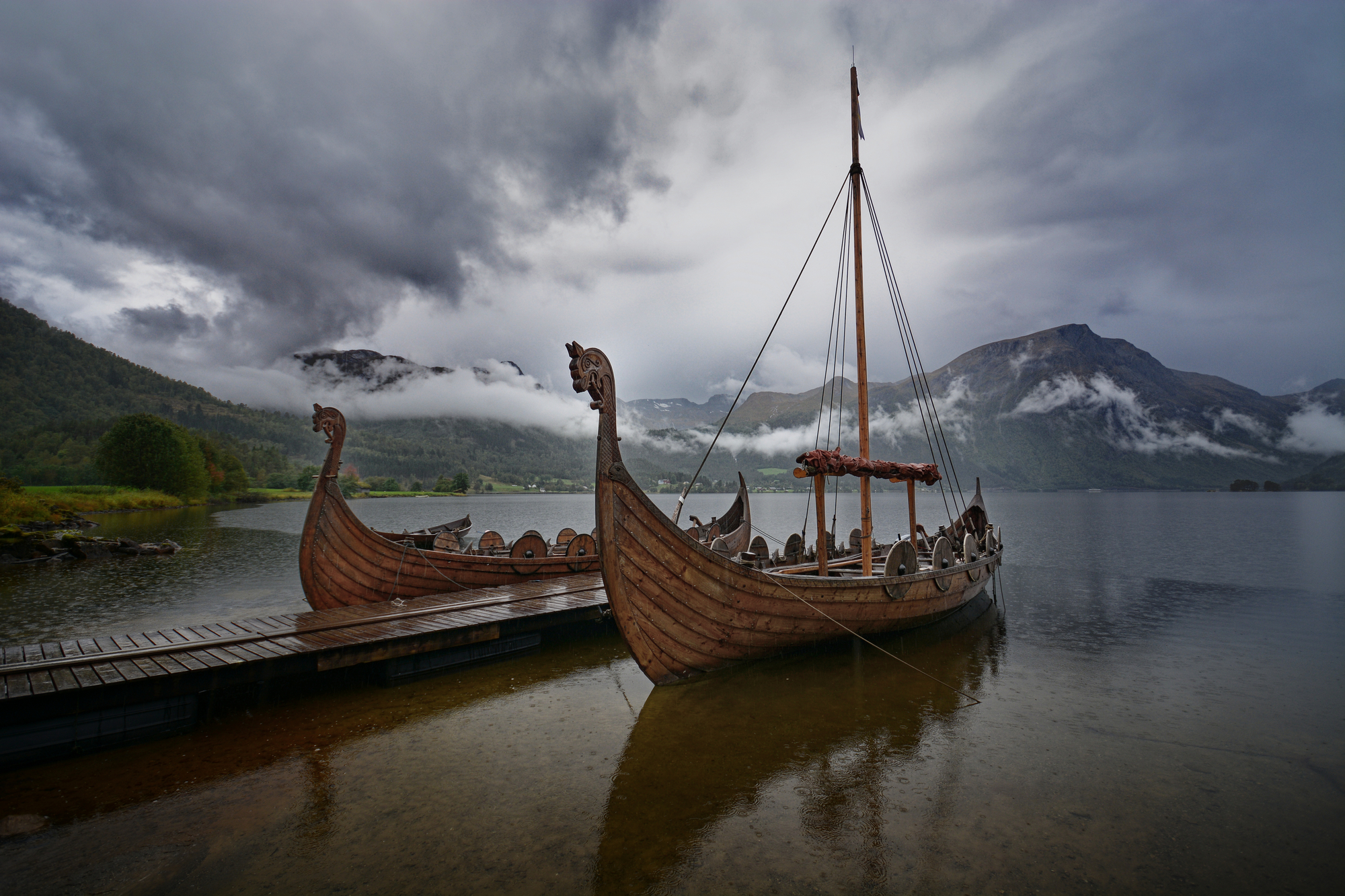
Vikings. 1000 years or so after the Viking Age and the word still resonates and excites today and it’s understandable that visitors to Norway want a piece of the action. And while (rightly) the focus is often on Norway’s greatest Viking artefacts and locations, there are also many other wonderful and crucially important places that you can visit to get a taste of the real Viking story. It’s a incredibly rich and interesting history. So, while we await the opening of the new Museum of the Viking Age in Oslo (perhaps late 2027), I have decided to pick out my own personal hidden gems of Norway’s Viking history. They are unashamedly slightly biased towards west Norway, where I live. But why should the Oseberg’s and Borre’s and Kaupang’s of this world get all the attention?! When I am out on tour with guests, I always like to point out the hidden gems in all of this incredible history.
In this list you will not find those incredible burial mounds at Borre, nor even the seat of unified Norway’s first king, Harald Hårfagre at Avaldnes. Nor will you find modern attractions based on the history of the Vikings, like Njardarheim viking village in Gudvangen, or the reconstructed Myklebust viking ship at Sagastad (though there is also the very real burial mound nearby too). These are on all the lists elsewhere. But this is a different list. A list that reflects the nuances of the story and the lesser-known people and stories of late Iron Age and medieval Norway. These places may not have the sense of immediate awe that standing in front of, say, the Oseberg viking ship might have, but linger and reflect in these places and they will give you a deeper and greater sense of the real Viking story.
So, here are (in no particular order) my Top 10 hidden gems of Norway’s Viking history.
1. Håkonshaugen, Seim – The Grave of a Viking King, Haakon the Good


Sometimes it’s difficult to be certain about names, people, and places in the Viking Age. But in this first entry in my Top 10 hidden gems of Norway’s Viking History, we have 3 different sources that all say the same thing. And they are respected documents – Fagrskinna, Ågrip and Heimskringla. And they all say that Haakon the Good, the Viking King of the mid 900s is buried at Håkonshaugen at Seim, north of Bergen. The fact that the farm here was in Royal hands from the time of Harald Fairhair until the 1400s adds weight to the evidence.
It could be that here at Seim is the only place that you can be fairly sure that you are in exactly the place that a Norwegian Viking King was buried. In all other cases, we are not so sure. That fact alone means that it is an interesting place to visit. Haakon’s story makes it unmissable – the clue is in his name, Haakon the Good.
Haakon’s nickname is pretty unusual in Viking Age. A Viking who was Good? It doesn’t fit the stereotype, does it? Haakon was the youngest son of Harald Fairhair and was brought up fostered by King Athelstan in England (that’s another story!) After Harald’s death Athelstan provided the necessary assistance and military support to Haakon to allow him to come back to Norway and outmanoeuvre his half-brother, Erik Bloodaxe (more of him in another of the Top 10 entries), who had been proclaimed King of Norway. Haakon’s promise of reforms to the taxation system led to Erik’s support falling away and Haakon began to earn his epithet of Haakon the Good. He also brought a Christian perspective from England and was the first to try to convert Norway, and did so using peaceful methods of persuasion, rather than threats or violence. He reigned from 934 until 961. But still he had to fight off the challenges from the sons of Erik Bloodaxe. After winning battles against them at Avaldsnes and Rastarkalv, he eventually died after being wounded at the Battle of Fitjar in 961, despite winning that encounter too. Haakon’s military success is credited to what he learnt about naval strategy in England. You can actually visit all of these battle sites, but to take the trip to Seim (a relatively short diversion off the main E39 road, north of Bergen) and be at his probable resting place, is humbling.
Here’s another interesting part of Haakon’s story. The saga sources also say that he was born at Håkonshella, just outside Bergen. If you have, or ever will fly in, or out, of Bergen airport, you will almost fly directly over this spot just after taking off or just before landing, on the north side of the airport! Fitting also that Håkonsvern, home of Norway’s modern navy is also right here (you’ll see it on the other side of the flight path), linking over 1000 years of history.
2. Kvernsteinsparken – Millstone Park


As the development of towns like Kaupang in the south showed, the Viking age Scandinavian population was extremely well connected to large parts of Europe through trade. There’s almost no better place to see in Norway that shows the physical evidence of that trading past than the remains of the millstone quarries in Hyllestad, Vestland. Having a stone to turn to grind grain was nothing new, but the Viking age population of west Norway turned it into an industrial scale production and an international trade. Having a millstone was a central part of living in these times – think of it in the way we do ‘white goods’ for our modern kitchens.
In Hyllestad, this production was so large and the trade network so extensive, that example of millstones quarried here have been found as far as northern Germany, Sweden and Iceland. Hundreds of thousands of them were cut out (by hand) from the unique garnet mica schist rocks of the area. Such was the importance of this trade that it extended from before to after the Viking Age peaking in the medieval period before the Black Death plague arrived in 1349. Even after this the quarries still produced millstones on a much smaller scale until the early 20th century. Quite remarkable, and fully deserving of a place on my Top 10.
If you want to see with your own eyes the physical legacy of Viking Age trade, then come to the open-air museum Kvernsteinsparken (Millstone Park) and walk around and feel the scale of what Viking Age Norway created here. Incidentally, the stone masons also turned their hands to the creation of the earliest stone crosses known in Norway in those first years of the conversion to Christianity. But more about that later in this Top 10.
3. Gulating – the seat of law in west Norway


When people think of the Vikings, they tend to have images of the brutal Viking raider, burning down villages and stealing silver. It’s what we were brought up on in school after all, and the Hollywood and Netflix image of the Viking is still dominated by this. In reality, Norway during the Viking Age was a society of relatively progressive ideas about decision making and justice. There’s no better example of this in the Ting system – a kind of cross between a decision-making assembly (like a parliament) and a court of law.
The Greeks often (and perhaps correctly) get the credit for the invention of democracy, but it was here in iron age Scandinavia that a system developed that was practical and could work anywhere. Direct democracy was impractical in Norway – getting around mountains and fjords meant that it made much more sense to someone to represent your village, or valley or fjord settlement to the Ting. This is the birthplace of representative democracy – the model that all democracies use in modern times. It was a model that Norwegian settlers took to Iceland, where their parliament is the one in all the world with the longest unbroken history.
The legacy of the Ting system can be found in the institutions of modern Norway too – Tinrett is a district court and Stortinget (the ‘big Ting’) is the name of the Norwegian Parliament.
Before Norway’s legal system was unified in the 1200s, the various regional Tings were a hugely important foundation in the functioning of early medieval Norway. In the Viking Age they were just as important and indeed, often ended up being at the centre of the power struggles as Norway became a unified Kingdom and struggled with the interference of power further afield, principally from Denmark.
In west Norway, the centre of the Ting system was Gulatinget – taking its name from the area, Gulen, where it was based. It’s strategically located close to the mouth of Sognefjord and central on the coast of west Norway. You can visit the site of where we think the Ting met at the Gulatinget visitor centre and park. The sense of history and legacy are just incredible here. This could well be one of the places that defines everything that comes after and our very modern sense of the world today. That surely is deserving of a Top 10 place.
4. Frostating – the seat of law in Trøndelag


If there’s one place in Norway that epitomises the spirit of the fierce independence of Norwegians past and present it’s Trøndelag. It’s not surprising that Trondheim, Norway’s first capital was located here. Trønders are not to be messed with. And so it was the case during the Viking age, where independence meant holding your local laws and customs dear and resisting the march towards a unified Kingdom. Convert to Christianity? Not sure about that. Swear allegiance to a King? No, I really object. Trøndelag became central in both politics and religion in Norway in the Viking Age. A substantial amount of material in the sagas attest to this.
This force of regional power also centred on the area’s legal system, the centre piece of which was at Frosta, just across the fjord from the vitally important power centre of Lade, and eventually Nidaros (Trondheim) itself.
Frosta is a beautiful area, and the Ting site is marked by a modern stone circle. There is a small, low-key museum next to the site and the interesting medieval church of Logtun. Also worth a visit is the little island in the fjord, Tautra, which can be reached by a permanent roadway. It’s the site of an important medieval monastery and now Klostergården is a real gem of a place to stay, eat, and most importantly, drink. One of the finest small breweries in Norway, in my humble opinion. All of which add up to a worthy place in my Top 10.
5. Rivedal – from where the settlement of Iceland began


On the northern side of Dalsfjorden, in the traditional district of Sunnfjord is a fairly unassuming farm area called Rivedal. Dalsfjorden is a beautiful and little visited fjord and it’s worth a detour in itself. But follow the road past the farm towards Askvoll you will see a large monument statue. It’s a bit of a strange case, as there’s nowhere to park, no signposts, but there he is, larger than life – Ingolfr Arnasson – who, according to the Landnámabók, was the first permanent settler of Iceland in the year 874. Landnámabók is the medieval work that details the settlement of Island in the 9th and 10th centuries.
The statue that stands here was erected in 1961, an exact copy of the one unveiled in 1924 in Reykjavik, Iceland’s capital – and the city which Ingolfr is said to have founded.
The story of Ingolfr is fascinating. He left because of a blood feud and in the context of the purges by Harald Fairhair in the immediate aftermath of the Battle of Hafrsfjord, which settled the question of a unified Norwegian kingdom in Harald’s favour. Ingolfr’s area was part of the lesser Kingdom of Firda, but one which was fiercely resistant to the new King Harald’s unification project.
The existence of Iceland was known already, but the sources tell us that Ingolfr was the first permanent settler (though some sources note that Irish monks may have already been there). The tale relates that on approaching land he threw the pillars of his head of household high seat over the side of the ship and vowed to settle where the gods (the old ones!) decreed that they would be washed up. This is the origin story of Reykjavik itself.
Interestingly, there is also a connection to the previous two hidden gems. Ingolfr’s son, Thorstein, a great Chieftain, is said to have founded the first Ting on Iceland and a forerunner of the Althingi (Alting), the unified Icelandic parliament and the one which still sits today.
Rivedal is definitely worth a visit – though it is difficult to park. Dalsfjorden has some spectacular natural beauty and seeing the statue of Ingolfr himself is quite profound, again given all that was to come later. As such, it’s very easy to include this in my Top 10.
6. Svanøy – the legend of Erik Bloodaxe


Erik Bloodaxe. There’s a name for you. A real Viking name. You may have not heard of him, but he was a significant figure in Norway’s Viking story. He is a little more obscure because of the relative lack of historical sources. But he is the son of Harald Håfagre (Harald Fairhair), he was King of Norway in the early 930s, and his younger half-brother was Haakon the Good (see number 1 on this list). Erik also ruled in the Kingdom of Northumbria located in the north of England, where it is said that he was eventually killed (though there is disagreement in the sagas about exactly where, by whom, and in what circumstances!).
The sagas paint a picture of a young, battling Viking, raiding violently over Europe. Other sources add in colour and disagreement on his later story, but the mix is clear. He is a classic Viking character, mixing it with the big boys of the age. Throw in the possibility his nickname comes from killing some of his own half-brothers, and the disagreement in the sources about his love life, and the story of Erik Bloodaxe becomes a compelling one.
Why, then, is he in my Top 10? The reason is because of the hidden gem of Svanøy – an island on the west coast of Norway, just south of Norway’s most westerly town, Florø (which happens to be the place to get the ferry to Svanøy). Svanøy, is where the sagas suggest that Erik may have been born, and certainly grew up here, serving his ‘apprenticeship’ under the local hersir (chieftain). Svanøy has a fascinating history and continued its importance beyond the Viking age.
You can stay overnight here at Svanøy Hovedgård – another sign of this island’s important past, visit the Norwegian Deer Centre and walk the places of Erik Bloodaxe’s youth. It’s a unique and despite Erik’s reputation, a calming and quiet place. A top 10 hidden gem, for sure.
7. Moster – the Christening place of Norway


Moster is a small island at the southern tip of Bømlo, which lies south of Bergen. One of Norway’s oldest churches can be found in Mosterhamn here. And it’s this church and the area around that adds this place to my Top 10. Now, I know what you are thinking – didn’t the Vikings worship the Norse gods like Odin and Thor? Yes, this is absolutely the case, but it also absolutely the case that Norway converted to Christianity during the later period of what we call the Viking Age. Indeed, many of the Kings and leaders involved in the Christian conversion are not easily separated from the behaviour of those earlier in the Viking Age.
Norway’s conversion was complicated, and often at the tip of a sword blade. It was seen as a way of bolstering economic and political power for Kings, but met resistance from the ordinary farmers, and from those that held on to the old gods. The fact that, even after Norway officially became Christian, echoes of these older beliefs persisted down the centuries shows how complicated the process was. But Moster, can lay claim to being the site of the Christening of Norway, a claim that surely justifies its inclusion in my Top 10.
Here at Moster, not one, but two extremely important events in Norway’s Christian history happened here, connecting, no less than 3 Viking Age Kings of Norway, and interestingly both events are associated with declarations at the local Ting, Mostratinget. The first of these was in 998, when the King Olav Tryggvason declared Norway a Christian country. He was not the first to attempt conversion, there were others, like Haakon the Good who tried, but Olav’s more ‘muscular’ approach was pivotal and his establishment of the Norwegian capital at Nidaros (Trondheim) set the stage for the real establishment of the church. Incidentally, Haakon the Good’s mother came from Moster, and it is possible that Haakon himself grew up here. Then, in 1024, King Olav Haraldsson (later to be St. Olav) announced that the basis of the law in Norway was in future to be Christian.
Moster and its visitor centre (and indeed Bømlo) is an easy diversion on the main road (E39) between Bergen and Stavanger. It’s really worth a visit if you are interested in the history of the Viking Age, but also the start of Norway’s journey to becoming a truly European Kingdom in the later Middle Ages.
8. Korssund – A tall story?


Korssund (Cross Sound) is a tiny place on the west coast of Norway with a big story. It’s about as off the beaten track as you can get. Although, in the past, with boat travel up the coast the only way of getting around, its position was more significant.
Today, you’ll find a little road leading to a small grocery shop, a stopping place for small boats, one or two houses. But you’ll also find something remarkable. A carved stone cross, planted in the ground next to the water, nearly 4 metres (12 feet) tall.
This cross may have been placed here as a way marker, a signpost, if you will, not only for navigation purposes, but also to display that this was Christian land, Christian rule. We are not sure of exactly when this cross appeared. It was carved in the stone quarries in Hyllestad (see earlier, Kvernsteinsparken) and it could be as old as the 10th century.
Why should this be in my Viking Age hidden gems Top 10, I hear you say? Well, it’s no doubt that it an impressive thing to see, and on a beautiful, quiet and hidden gem part of the Norwegian coast. But I mentioned a big story. And they don’t come much bigger than the one here at Korssund.
The story can be found in the Saga of Olav Haraldsson – yes, that’s the later Saint Olav, and the one who is mentioned in the previous entry in my list about Moster. Now, as a King has little time to move around and get his Kingly business performed, there is little more inconveniencing than a big piece of rock blocking the passage of your boat while getting around. So, the Saga says this happened at Korssund. But as God’s appointed King in Norway, this is of little consequence if you can simply just part the rocks and allow the water to flow between. Let’s call it Norway’s parting of the Red Sea but in reverse. Thereafter a cross is put here to mark the miracle, and the name is given to the water way Korssund (Cross Sound).
Didn’t you know Vikings could perform miracles? Surely a Top 10 hidden gem!
9. Solund & Utvær – Last port of the Viking raiders


Solund and Utvær are some of Norway’s most westerly islands. In fact, Steinsøyna, out from Utvær, actually is the most westerly point of Norway. From here, it’s actually only 375 km (250 miles) to the Shetland Islands. Closer to Scotland, then, than Oslo.
This is the place where Viking raiders would have their last chance to do, well, whatever Vikings might need to do, before they set out over open waters to reach the British Isles. One thing they probably would want to do is sharpen their swords for the last time. Good to have a sharp sword, when raiding. Here on Utvær there is a stone, with carved grooves in it. It’s difficult to know for sure, but it is highly likely that this stone was used for exactly this purpose. It’s place here on Norway’s most westerly point, perhaps, no coincidence. It’s a remote, beautiful and wild place – and to run your fingers across the grooves in this rock is to run your hand through the story of history.
Between Utvær and the mainland are the islands of Solund, which also play their significant part in the Viking story. Solund’s position on the Norwegian coast made it a natural muster point, a natural harbour of islands and inlets, and at a point where major geographical navigation markers were difficult to miss (the entrance to Sognefjord to the south, and the prominent mountain island of Alden to the north). During the Viking Age it was a strategic waypoint.
And it was here in the summer of 1066 that the Norwegian King, and perhaps the last of the great Norwegian Viking Kings, Harald Hardråde mustered a fleet of around 200 Viking ships and their warrior crews. His goal was to press his claim to the English throne. In September he set out, gathering more forces in Shetland and Orkney (which were part of Norway at this time), and then at Scotland’s ancient capital, Dunfermline, where my namesake, Malcolm III, assisted Harald’s efforts with a further 2000 troops. It’s a little-known fact that perhaps up to 20% of the Viking King’s army by the time it reached England was made up of Scots!
The rest, as they say, is history. At the Battle of Stamford Bridge on Sept 2th, 1066, Harald fell and the Norwegian claim to the throne of England with it. English historians have subsequently termed this as the end of the Viking Age. Hmmm, not entirely so sure about that, but it has been broadly used as such. But if this event was the end, then the start of its story happened in Solund in the spring and summer of 1066. Coming out to Solund on the ferry and taking a small boat out to Utvær is an incredible experience, but surrounded by its history too, then that’s priceless. Consequently, it’s in my Top 10 hidden gems of Norway’s Viking History.
10. Stiklestad – Norway’s most important Viking Age battle site?


Stiklestad is a small area north and east of Trondheim in that hotbed area of resistance that is Trøndelag that I mentioned earlier in talking about the Frostating. And it was here in 1030, that everything changed for Norway. And it did so in a strange way – with the losing side in a huge battle, ending up the victors in a way, in the long run.
The story of Stiklestad involves once again, Olav Haraldsson, the King who struggled to keep his Kingdom together, his throne intact, and his family, associates and ‘subjects’ loyal. He did not have his troubles to seek. And when the farmers of Trøndelag also revolt, then clearly you are in trouble. All of which led to a fateful final confrontation between the powers of the old and the new. The old being the farmers, clinging on to their independence and some their old ways of the old gods. The new, represented by Olav, a Christian Royal order leading Norway towards its future at the table of other European Kingdoms. Yet at the Battle of Stiklestad on July 29th, 1030, it was the new that was defeated, with Olav, also, killed in the conflict. Harald Sigurdsson, his 15-year-old half-brother – later to become Harald Hardråde – escaped with his life to fight another day.
What happened next is quite remarkable. With the King dead, the Danes muscled in but proved even more unpopular. All the while, rumour, legend, myth began to swirl around the fallen Christian King Olav. Within a year of his death, he was made a Saint. And thereafter his story, his legend became a legitimising and unifying force in medieval Norway and one which still, in some measure, persists until this day.
A visit to Stiklestad is very rewarding. I always find being in the place where something truly significant happened very compelling. But also here you will find a National Cultural Centre and replica Viking longhouse, amongst a host of other interesting things. Come in July, and you can enjoy an outdoor dramatization of the story – Spelet om Heilag Olav (The drama of Olav the Holy). I’ve been myself, and it’s an easy entry in my Top 10 as a result.
