
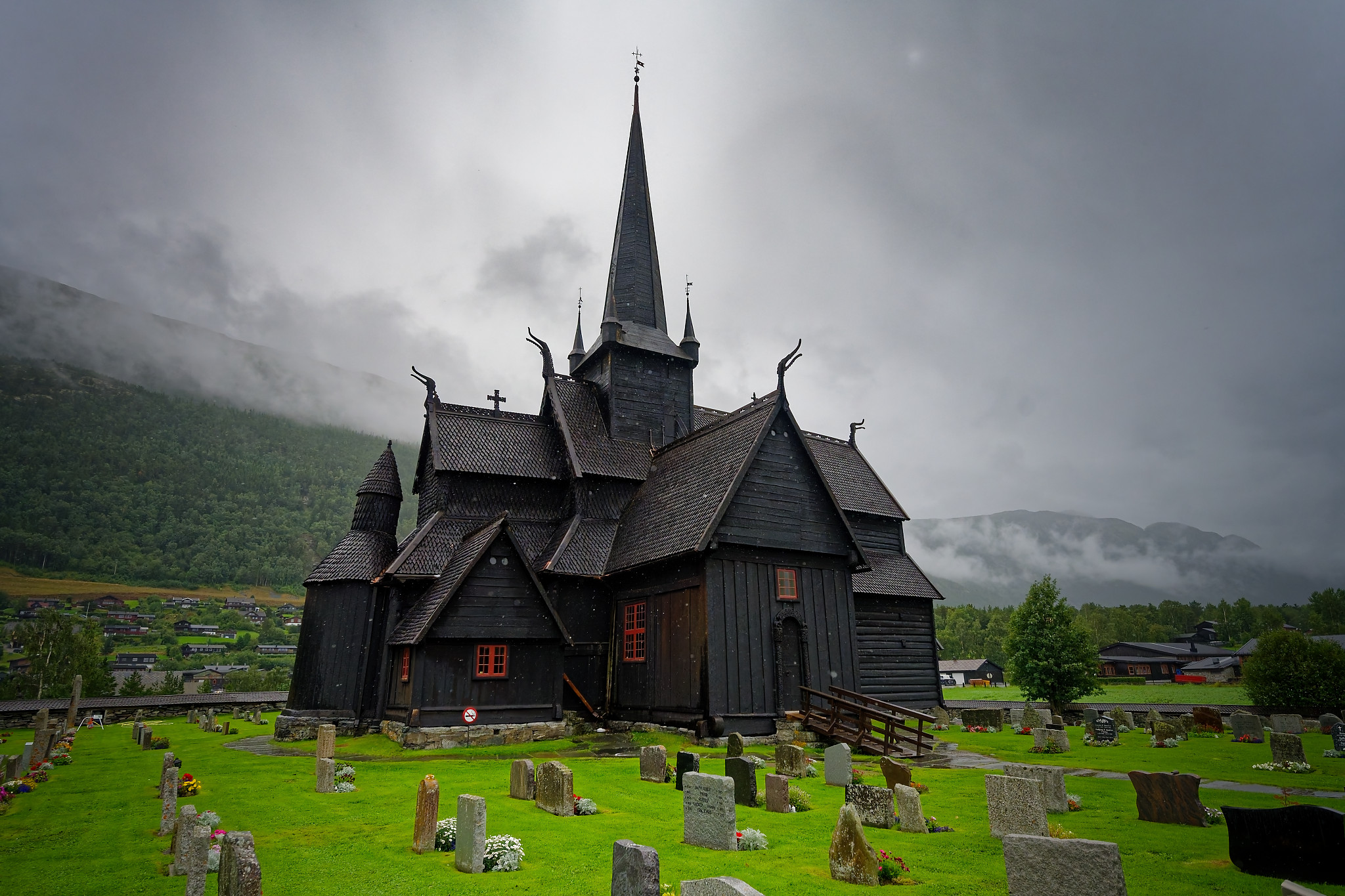
It seems many of you have as strong as mine for the stave churches in Norway! Hundreds of you have now visited my previous post on what I considered to be my Top 10 of the 28 stave churches remaining in Norway. But many of you reminded me of some of the ones I had not put in the list, and I realised that I shouldn’t just stop at the first 10. If you haven’t yet read about the very best, in my humble opinion, or you want to remind yourself what those were, then catch that post here.
So here is my second instalment of stave church magic. This time covering those I place 11 through to 20 in my list of the best ones. Again, this is a personal set of choices, and I will also try my best to explain why I consider these to be not quite worthy of my original top 10. Many of the reasons are to do with the extent to which the building and/or its interior are authentic and original, how much restoration and remodelling there has been and the key question of whether the church offers an experience of the time and place when it was first built. That is very difficult in some cases, due to the modernisations, rebuilding and extensions that have taken place at many of the churches on this ‘11 to 20’ list. But don’t get me wrong – I love each of these buildings, and all of them have fascinating stories and rich history attached to them. So don’t feel in any way that this is a list of ‘second best’. It’s a second Top 10 in many respects. This is still a list of wonder, interest and beauty.
So, here are my best Norwegian stave churches 11 through to 20 and a little of my own ideas as to why. As usual, the list is in no particular order (that’s just impossible)!
11. Hopperstad


Hopperstad in Vik, on the south side of Sognefjorden, seemed like a shock omission for some people when it did not make my Top 10. It’s surrounded by extraordinary natural beauty – mountains all around and the King of the Fjords, Sognefjord nearby. It’s also in a place with a long history. A place where people have dwelled and been able to find riches in the good farming land in between the mountains. Archaeology tells us that it has been a power base and important centre for perhaps several thousand years and a decorated sword from the Viking Age was found very close to Hopperstad indicating the wealth that was present in that time. So why then, did it not make the Top 10? There is a very straight forward reason for that, and it is because of the more recent restoration work that was necessary in the 1880s due to the church being in such a poor condition. It was, in fact, very nearly pulled down altogether. But architect Peter Andreas Blix saved the building and undertook a restoration that reimagined the exterior in a similar form to the stave church at Borgund. This means that a great deal of the exterior that you now see at Hopperstad is in fact, only around 140 years old. It was this reason, and no other, that I decided to put this one in the group 11 to 20. It still has its magnificent door portal carvings. Hopperstad has many really important features on the inside – and can claim to being one of the oldest stave churches too, perhaps as early as 1130. Indeed, dendrochronological analysis suggests that some of the wood was even reused from an earlier building with dates back into the 1000s. There is a replica of the Hopperstad Stave Church at the Hjemkomst Center in the city of Moorhead in the state of Minnesota in the United States.
12. Lom


Lom was another church that many of you commented should have been in my Top 10. And in many respects, just like Hopperstad, there would be very good reasons to have included in the list of the best 10. But, again, like Hopperstad there are reasons for my choice, and this time, it is not to do only to do with the exterior (which has had extensive changes), but also to do with the interior. The oldest parts of the church do date to around 1170 – some of the wood was likely felled even earlier, and there are (like many of these churches) signs of a previous, older church underneath. It may have looked somewhat similar to Borgund originally, in that it had an exterior open corridor around its edge. However, in the mid-1600s, these corridors were removed, and the church was significantly altered and extended with the addition of transepts, a new roof, enlarged nave and a new modern innovation – windows! The interior decoration and furniture almost all date from after this period of change. Of course, churches are living buildings and the work done in the 1600s reflected the need to accommodate a larger number of people, but it does mean a lot of the original medieval character has been lost. Lom is still worth a visit, for sure. Its setting at the gateway to the Jotunheimen and Breheimen national parks is impressive, and, of course, you can also take a visit to the nearby Lom bakery too!
13. Undredal


Undredal is Norway’s smallest stave church. Perhaps that fact alone should have warranted its inclusion in my original Top 10. However, like the case of Lom I have just discussed, the changes to Undredal’s exterior and interior mean that almost all of the original medieval stave church character has been lost. Indeed, so radical were the changes at Undredal, that it was not even realised until the 20th century that its core elements were, indeed, that of an older stave church. Undredal is still a working church, but it continues to be tiny. It’s just 12m x 4 m (39 feet x 13 feet) and sits around 40 people. Its inner oldest parts date back to 1147. The church was altered and extended (yes, it was even smaller!) in the 1600s and again around 1850. The roof was remodelled in the 1860s. In the early 20th century, there were plans to remove the church to a museum site at Kaupanger, however not enough funds were raised to build a new one. So, the church remained and was again restored in the 1980s (the current tiled roof dates from this time). Through the centuries, Undredal stave church has remained at the centre of this tiny village community – only joined to the outside world by road in the 1990s. It saw a lot of emigration in the 1800s and yet it has survived and still serves the small community today. The interior has some interesting painted decorations and depictions – possibly dating back to the 1600s. Undredal is well worth a visit. If I was judging things by the setting alone, Undredal would easily be in my Top 10. The village and its location of Aurlandsfjord is nothing short of spectacular. If you are visiting, do try the traditional brunost (brown cheese) made from the milk of the goats who actually outnumber the people in the village!
14. Torpo


Torpo is the last remaining stave church in Hallingdal, lying between Geilo to the west and Gol to the east. There was a stave church at Gol too, but it is now located at the Norwegian Folk Museum in Oslo, and I will return to its story in another post. We also have a lot of information about the stave church that did stand at nearby Ål but was one of the churches that was lost in the final round of demolitions and removals in the 1800s. Thankfully Ål’s incredible door portal carvings were saved. Torpo also has some remarkable portal carvings and most likely an original door too. Its core stave construction dating from the late 1100s remains and is very similar to that of Gol and of Borgund. The geographical proximity of Borgund across the mountains shows that it is very likely that the same teams of builders and designers may have been involved in each case. In fact, we actually know who built this church. A runic inscription inside the church reads pretty much like this: Thorolf built this church. What’s even more interesting is that Thorolf also signed his work at the Ål stave church too! Some of the other craftsmen’s names are also included. The church building was in private hands (not unusual in Norway) until bought by the municipality in 1875. It was also during this period that part of the church was removed due to its poor condition – which accounts for its unusual shape today. However, the municipality’s plans to extend and change the building to accommodate more people was objected to by the Norwegian National Trust (Fortidsminneforeningen). In the end, the municipality built a new church, literally right beside the stave church. So, today, they stand side by side. The later added windows, give a large amount of light into the interior where you really get an impression of the height of the wooden construction. Also of note, is the carved shape of a human figure on the floor. This marks the spot where previous research revealed the buried body of an important individual – a local legend says that it is a Bishop of Stavanger, although there is no actual evidence of this.
15. Rollag


Rollag stave church lies in the heart of an extraordinary valley – Numedal. With the highest concentration of medieval wooden buildings anywhere in Norway, and no fewer than 4 stave churches, Numedal is really worth an extended visit. The stave churches at Uvdal and Nore further up the valley both made it on to my Top 10 list. So why did Rollag not also do so? That’s, again, mainly because the amount of change, alteration and rebuilding that’s happened historically. It’s a church with a very different character to Nore and Uvdal. It underwent numerous changes from around the mid-1600s through to the mid-1700s. Indeed, you really must look under the skin of Rollag to find the remaining medieval elements. They are there, and they are also, like Uvdal and Nore, dated to the second half of the 1100s. I love the setting of Rollag, sitting, as it does, above a large bend in the river Numedalslågen. It’s also very close to the Numedal Medieval Centre – just across the river – where a lot of the valley’s traditional hand crafts and skills are being kept alive with summer workshops and events. I really do recommend a visit to Numedal. It really is one of Norway’s absolute best hidden gems.
16. Kaupanger


Kaupanger stave church in the historic district of Sogn is the largest stave church in west Norway. It has an impressive 22 stave columns supporting its structure. The area was an important one during the Viking Age and into the later medieval period and is just along the fjord from the site of the Battle of Fimreite in 1184. The battle was a naval engagement fought out in the fjord between competing Kings Magnus Erlingsson and the Birkebeiner supported Sverre Sigurdsson. It’s thought that an earlier stave church was a victim of a revenge fire by forces loyal to Sverre at the time and therefore the current one must be no older that the very latest part of the 1100s. However, recent dendrochronology research on the wood suggests that the church has been there since the 1140s. This may suggest it was not victim to the fire in 1184 that afflicted the town of Kaupanger. This may make some sense as the church is built quite a distance up from the fjord where the trading town of Kaupanger was located. The stave church’s appearance has changed significantly down the centuries – extended and remodelled in both the 1200s and again in the 1600s. But it was the restoration work done in 1862 that has caused the exterior of the building to be changed radically from its original state. Without real thought to the idea of preservation, windows were put in and a lot of the exterior panels were replaced by modern white painted ones. This rather ‘brutal’ attempt at modernisation was undone in further work between 1959-60. Kaupanger is often missed by those travelling on the Rv 5 road between Lærdal and Sogndal. But it is only a 5-minute diversion off the main road, and I would argue, definitely worth it a stop.
17. Lomen


I wonder how many people drive up and down the busy E16 road between Vang and Fagernes and pass by Lomen stave church without realising it is there (you can easily see it from the road). Yet, park just off the main road at Lome and it’s a three-minute walk up the hill. We know that the interior is the oldest part of the church and dating to around the end of the 1100s. More recent excavations have found artifacts and coins from an earlier period in the 1100s. This perhaps suggests an earlier usage at the site – much like many of the stave churches. It’s important to note that these early churches were often built on sites that were considered ‘holy’ and that might also extend back into pre-Christian times in some cases. Here, at Lomen, we can’t be certain, but the Valdres valley has been an important passageway between east and west Norway pretty much as long as there have been people here. The exterior of Lomen church gives it an appearance of being bigger than it actually is once you get up close. Its high walls, and small tower rebuilt in the mid-1700s and yet ended up in such poor condition by 1895 that it was considered a danger to people – leaky, cold and wet. However, it was saved when 20 or so years later it was agreed that a new church would be built further down the valley. Lomen has some beautiful door portal carvings (especially the inner part of the west door). Its setting above the Valdres valley is quite magnificent. Just to get up and close to it will take you 10-15 minutes stop at the E16 – not to be missed, if you are passing.
18. Høyjord


Høyjord, down in Vestfold, is the most southerly of the still existing stave churches. It is a bit off the beaten track, but well worth finding, if you can take the time. It’s still a proper working church too – one of the few remaining stave churches that is. It’s also one of only 3 that has main stave columns in the middle of the construction (like Nore and Uvdal in Numedal – a little further north). The oldest part of the church is the chancel at the eastern end – built between 1150 to 1200. You are getting familiar with that date period now, aren’t you? About a century later in 1275 a much larger nave was added, which forms the major part of the interior today. The stave columns are very interesting at Høyjord, as each has its own design – a fairly unique feature. It also in those times had an open-air corridor around the whole building. However, by the mid-1800s, such was the state of disrepair, the corridor was removed. In the 1840s panelling and quite large windows were installed inside. By 1869 it had ‘modern’ panelled walls on the outside too. And into the 20th century, it was painted white and looked much like any other modern church building constructed in the great church renewal programme of the late 1800s. After the second world war, it was decided that the modernisation had gone too far and so some of the changes were reversed – new exterior panelling replaced the ones deemed to be too modern and the roof and tower were replaced and modelled on a stave church that had stood in Hallingdal at Nesbyen. During all the post war work it was found that the nave and chancel were largely original and interestingly 5 bodies were discovered in a shallow grave in the chancel – a man, 2 women and 2 children – dating to around the time of the Black Death in the mid-1300s. Although much altered, Høyjord is a must if you are a stave church addict. The interior staves alone are worth a look, and the church’s setting in the rolling farmlands of Vestfold set it apart from its more northerly cousins.
19. Høre


Høre stave church is barely 5km (3 miles) from another church on this list, Lomen. On its north side is the tightly packed farm and dwellings of Kvien – because of the historical klyngetun that was part of the landscape here. A klyngetun is a group of separate farms that have been deliberately built right next to each other – often because of the need to share a common resource, like a river. It’s likely that there was a previous wooden post church (a church with supporting posts placed directly into the ground) that was built in the 1000s. Towards the end of the 1100s, around the year 1179, this older church was replaced with a stave church on roughly the same site – you will now recognise the pattern in comparison with others. Dendrochronological analysis of the wood dates it to 1178-1179. A runic inscription upon the medieval pulpit reads: “Þá, um þat sumar [létu] þeir brœðr Erlingr ok Auðun hôggva till kirkju þessar, er Erlingr ja[rl fe]ll í Niðarósi” which broadly translates as follows: “The brothers Erling and Audun had the timber for this church felled, the summer that Erling Jarl fell in Nidaros”. This may well refer to the Battle of Kalvskinnet which occurred in 1179, and which corelates with the dendrochronological evidence of the wood having been felled in 1179. There are several other runic inscriptions, and items with runic inscriptions in Høre stave church. And in common with others too, there are a number of graves under the church, including those of children. Some of these even pre-date the present church and may be part of a burial pattern associated with the previous wood post church. Over the centuries, the church has been variously repaired and remodelled several times including in the 1660s, 1680s, 1724, 1740 and more extensively in 1822. There were further renovations done again in the late 1800s and as recently as 1970. It’s been well looked after, but this means it has lost much of its medieval character. The most recent work to repair the floor in 1979 revealed a collection of over 300 coins the oldest of which dated to the 1040s. Høre has had a fascinating history, and the fact that science, runic inscriptions and the sagas come together here to prove its age is one of the most interesting stories of any of the stave churches.
20. Kvernes


Kvernes stave church on Averøya, Nordmøre, is the baby of the family. Originally thought to date from around the 1400s, more recent research in 2020 found that it was, in fact, built as recently as 1633. Still very old, for sure, but it does make it the only stave church originally built after the medieval period and therefore is the youngest of the remaining stave churches in Norway. Kvernes stave church is typical of constructions in the Møre region where it is found. These types of construction are characterised by an absence of reinforcement in the corners. This makes the building less stable than other designs, and it is why it has diagonal external support posts, known as skorder, to support the walls. This makes it very distinctive. It stopped being used as an active church in the 1890s when a newer church building was constructed nearby. It is now looked after by the Norwegian National Trust. The area is full of history – this corner of the island has evidence of being a special place for centuries – there’s evidence of a stone circle here that may have been part of a Tingsted (a place where the local law assembly took place). Directly across the fjord you can look over to Frei where the Viking Age Battle of Rastarkalv took place in 955 between Haakon the Good and the sons of Erik Bloodaxe.
