
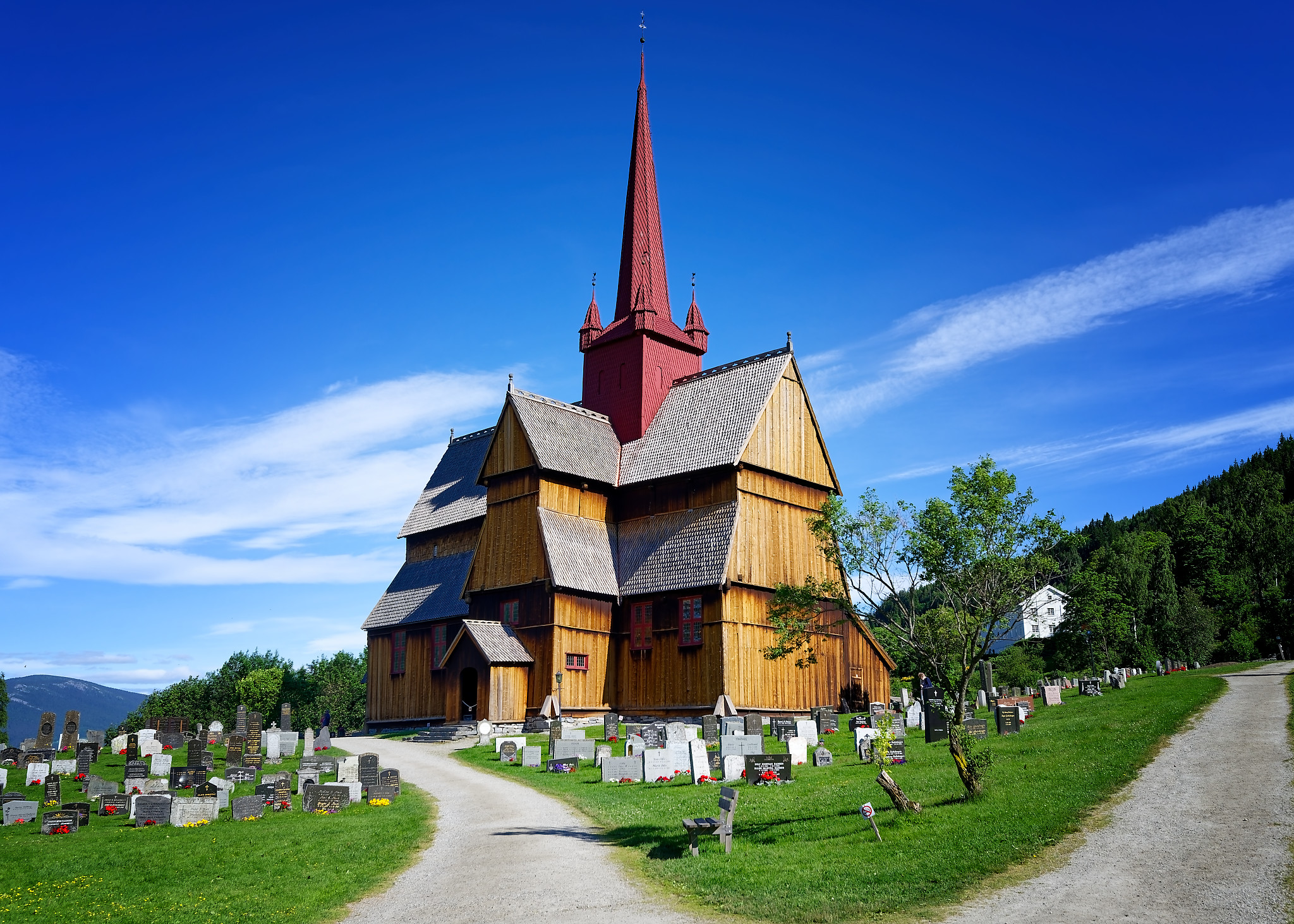
I have a confession to make. Ringebu stave church does not feature in either my Top 10 Stave Churches in Norway blog post, nor does it feature in my 11 – 20 either. The key reason for this is that it was until last week, it was one of the 28 remaining stave churches in Norway that I had yet to visit. So, do I change my mind now I have seen it inside and out? Well, it’s certainly impressive – and is one of the largest. Built around 1220, it remained largely unchanged until the Reformation in 1536. One hundred years later, in 1630, the church was rebuilt and the following year it received the characteristic red tower. The stave church is the local parish’s main church and is therefore still in daily use.


In 1980–81, archaeologists excavated and explored the ground beneath the current church. Incredibly, a hoard of coins was found – 900 in fact. Most of the coins date from the time when Håkon Håkonson was King of Norway in the period 1217–1263.
Post holes were also found that indicate an older church that had been built on this site, likely in the 12th century. An echo of this earlier church can be found in the well-preserved baptismal font, carved in soap stone.
Before the rebuilding in the 1600s, the church would have looked quite different, with arcades, perhaps similar to those found on the stave churches at Borgund and Hopperstad. During the rebuilding work the nave, aisle and apse were removed, and the ceiling inside the church was made considerably lower. Records show the church was first painted in 1717. It was painted in a style popular in the 1700s whereby surfaces were daubed to make them have the appearance of marble. A strange choice, I feel, but that was the fashion, though today, it makes the interior slightly strange in character, compared to other stave churches. Even the exterior was made to look ‘modern’ and was completely white. Restoration work in 1921 reversed this.


I realise I haven’t answered my own question – do I change my mind and give in a place in my Top 10? No. The interior redecoration takes it too far from its Middle Age appearance, as does the rebuilding of the outside. You may remember this is a key criterion that I’ve used to select the other churches.
However, there is one powerful reason for not diminishing Ringebu in any way. It has a wonderful story, a legend, attached to it. And it’s one that’s at the heart of a recent literary phenomenon here in Norway, and more recently, abroad.
Ringebu and the legend of the Sister Bells
The novelist Lars Mytting comes from Gudbrandsdalen, just down the road from Ringebu. In 2018 he published the first in a trilogy of novels set in the fictional village of Butangen in this part of Gudbrandsdalen. Søsterklokkene (The Sister Bells) quickly became a literary success in Norway and is now translated into 17 languages. In English, the first novel is called ‘The Bell in the Lake’. The trilogy follows the fortunes of a farming family, the local priest and the village stave church from the period around 1880 through to the Second World War. At its heart is a re-imagining of a legend associated with Ringebu stave church.
The original legend of the Sister Bells in Ringebu Stave Church is an old legend – though we are not sure exactly how old. It was first recorded and written down in a collection of folk tales from Ringebu by Iver Kleiven in 1928. I’ll retell it here, but rest assured that this is not a spoiler for reading the Lars Mytting books.
It’s said that the church bells were given as a gift by a family from the Vestad farm (a little east of Ringebu) sometime in the 18th century. The farm was home to two Siamese twin girls, perfectly healthy and strong. However, one day one of the sisters became ill and the family feared that she may die. Naturally, they prayed for her to be restored to health, and they made God a promise. If she survived, they would donate a new set of bells to the church. The girl recovered and the family kept their promise.
Two bells were cast and hung in the church. As a result of the story, local folk called the bells ‘the sister bells’. It was clear there was something special about them as they rang so beautifully – so much so that folk thought they must be made of silver. Rumours about these wonderful church bells travelled all the way down Gudbrandsdalen and eventually to Christiania (what is now Oslo). Clearly someone thought that a village church should now have something so wonderful, so it was decided that one of the bells should be taken to the city and used in a church there.
In this part of Norway, it is sometimes easier to transport things over lakes that are frozen, so while there was firm ice on Lake Mjøsa, one of the bells was taken down and packed on a sled for moving. But out on the lake, the driver noticed that the ice was starting to break up. The driver turned to go back, but fearing ridicule he eventually decided to resume the journey to Christiania. But then the ice broke and the bell tipped off the sled and sank to the bottom of Lake Mjøsa.
When spring came the bell was found and an attempt was made to bring it to the surface using ropes. With some effort the bell emerged from the water, but just before it was brought safely on to a boat, someone shouted out prematurely that “Now we have her”. Just then, the rope broke and the bell sank to the bottom once more.
The Sister Bells trilogy by Lars Mytting is an incredibly rich exploration of life, culture and change in this part of Norway (and indeed Norway as a whole). It’s essential reading for anyone who has a love of Norway, it’s past, its folklore and stories, and the way the past echoes through the ages to the present day. I’d read the books before I went to Ringebu. Now, I want to read them all over again.
Lars Mytting – The Sister Bells Trilogy
- The Bell in the Lake
- The Reindeer Hunters
- The Night of the Scourge
https://www.larsmytting.com/the-sister-bells-trilogy


